Conference & Festival 2026
This year our theme is Christ's quote from the Gospel of St John.
" Peace I leave with you; My peace I give unto you. I do not give to you as the world gives. Do not let your hearts be troubled and do not be afraid."
Christ says that He gives us His peace, carefully underlining that His peace is not the same as the peace that the world gives. He then goes on to reassure us, and ask of us something important that ties into our ability to receive His peace: not to allow our hearts to be troubled or afraid.
By focusing on the Peace given to us by Christ, the 2026 Conference & Festival will address some of the ways in which we can start to dispel the anxieties and fears that the Lord so much wants us to leave behind us.
Book by March 23rd to make sure of your place!
What is the Deanery Conference and Festival?
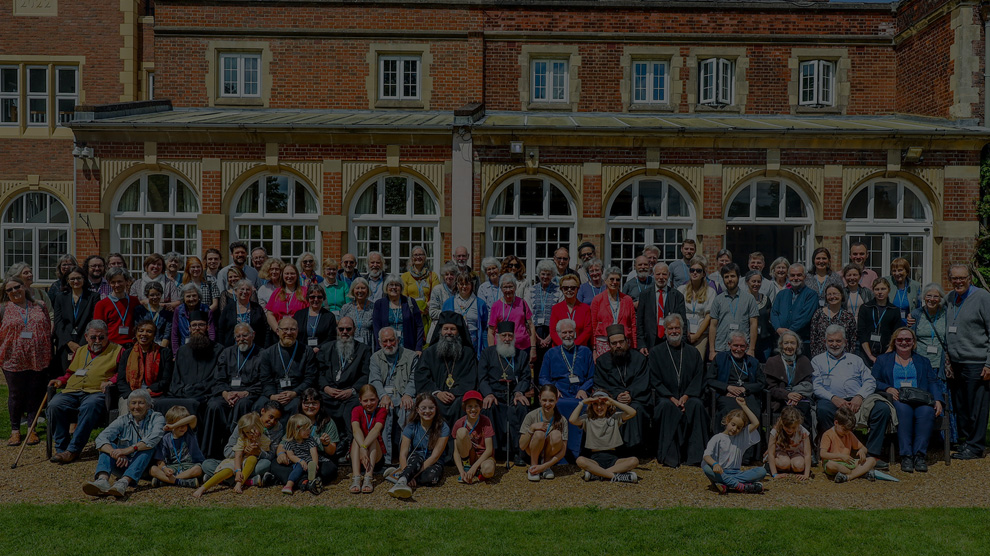
The annual Deanery Conference & Festival is a unique church gathering with origins going back to 1975 . It is organised by the Thyateira Deanery of parishes of Russian tradition, but members of other parishes in the Archdiocese are especially welcome to take part. We welcome families to attend and we run a full Children's and Young Adults' Programme.
Why do we call the event both a conference and a festival? There is the opportunity to listen to talks , discuss what we have heard and participate in workshops. And the whole event is a celebration of the Orthodox Christian culture that unites our church family. It celebrates the special joy of praying and spending time with Orthodox Christians of all ages from across the country. Through learning together and sharing
a common life, even if only for a long weekend, we grow in awareness that we are one Body of Christ, with a shared faith and identity as Orthodox Christians.
The Conference & Festival takes place over the late spring Bank Holiday weekend, from Friday evening to Monday lunchtime. For some years, it has been held in the beautiful setting of High Leigh Conference Centre, Hoddesdon , Herts.
Each year's event has a particular theme and our regular programme includes:
- 5/6 talks on aspects of the theme, with questions and discussion
- Daily services including a Sunday Liturgy
- A bookstall and special workshops for closer discussion
- Sunday evening party with an informal concert
- Free time for conversation, walks, videos, extra presentations/activities etc.
“Love begins with the recognition of the other as someone who has all rights of existence and not only rights connected with ‘mine', and then in serving the person according to the Gospel, according to what God says to us.”
Metropolitan Anthony of Sourozh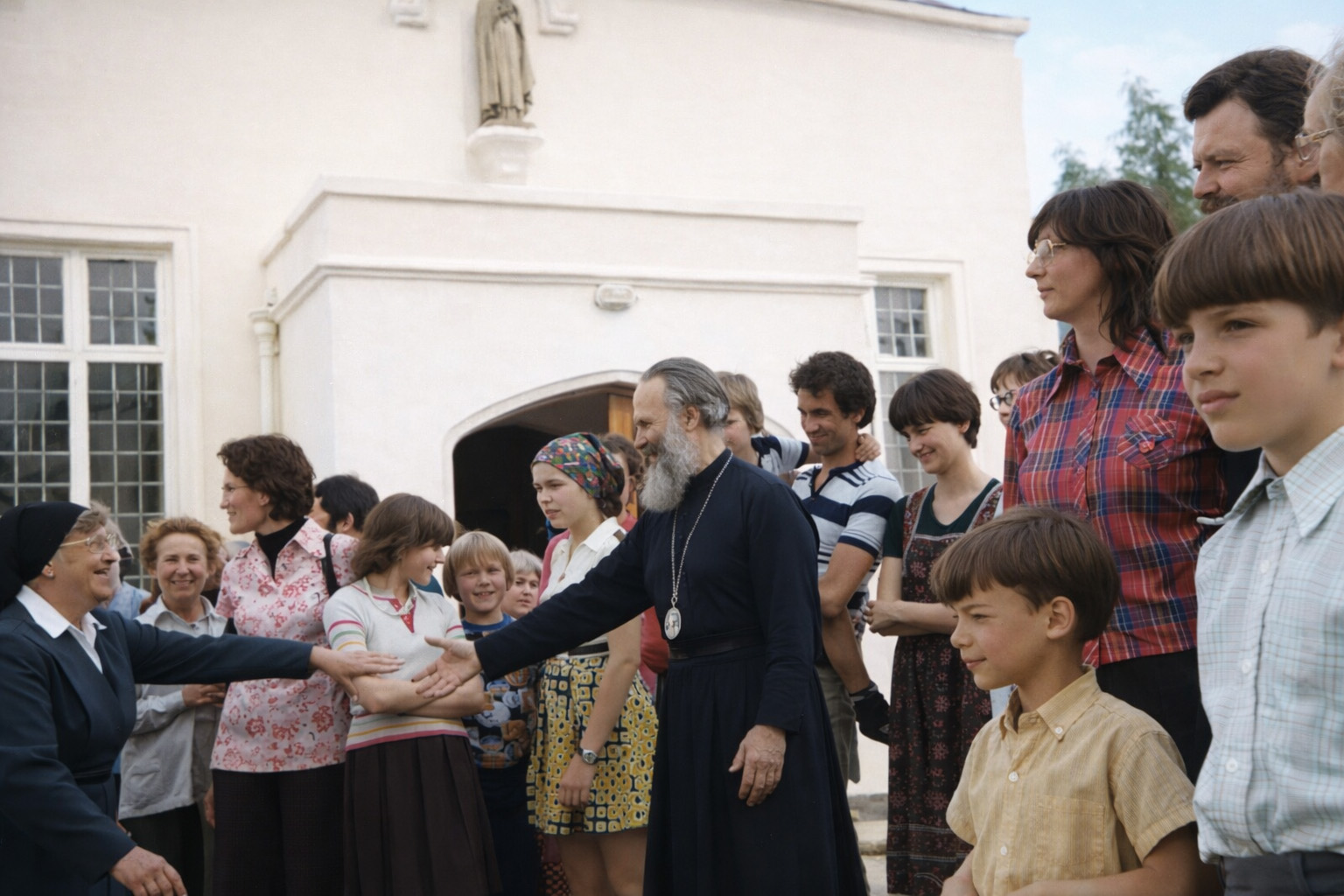
The Origins of our Conference
Our conference has its roots in Metropolitan Anthony’s lifelong endeavour to restore to the church its true conciliar nature, free of structures of power.
His vision was clear: ‘Our vocation is to be an icon of the Holy Trinity. Structures must express this, forms which express relationships of love, freedom, holiness that exist within the Holy Trinity.’
In the spirit of this vision he organised the first diocesan conference in 1975, which in form was an image of the church as the body of Christ gathered around its bishop in a hierarchy of love.
He saw that the bishop did not command from above but was at one with his clergy and people, each person unique, precious, made in the image of God. In this it recaptured the role, the dignity, and the holiness, of the laos, the Royal Priesthood to which everyone, including bishop and clergy, equally belonged.
It was a vision of mutual responsibility and cooperation, ‘Sobornost’, each member of the body given full possibility to express his views, to enrich others with his experience, to teach and be taught, to give and to receive, in an effort to work out a common understanding and a united heart.
The present conference is the fruition of many years of trying to grow into this vision - a vision which can be expressed in precise and practical ways: in the balance of speakers, equally divided between clergy and lay men and women; in the programming of dialogue as a driving force towards encounter, openness to new things and acceptance of others in all their otherness; and in its liturgical services, in which all are gathered as one in a union of love, under the ‘shelter of the wings of God.’
History of the conference
The Beginnings

When Metropolitan Anthony created the Diocesan Conference in Effingham in 1975 it was, like the Diocesan Council and Diocesan Assembly outlined in his Diocesan Statutes, a part of his attempt, based on the Moscow Sobor of 1917-18, to restore to the Church its vision of conciliarity based on the great councils and synodical tradition.
This was a vision that had been obscured and distorted by the Church’s relationship to the State and structures of power. The Statutes he created (and with them the Conference) were an image of how the Church can and should function. The first conference brought together people who had never met one another before, to work together with others not just to achieve a common goal, as in so many secular endeavours, but to express in practical action the Church’s being as a living example of conciliarity.
The Form
In form it was an image of the Church as the body of Christ gathered around its Bishop, in a hierarchy of love that was itself an image of the Holy Trinity, in which all the Persons share in the same attributes, properties and powers of the divine nature, but each function in a unique and distinct way in order to reveal one, common nature. The Bishop did not command from above, but was surrounded by, at one with, his clergy and people in a Eucharistic community, all of whom were recognised as playing a vital part in the pastoral life of the Diocese. In this it recaptured the role, the dignity, and the holiness, of the laos- the Royal Priesthood, the people of God - to which everyone, including Bishop and clergy, belonged.
The vision
It was a vision of mutual responsibility and cooperation: Sobornost, in which each member of the Church was given full possibility to express his views, to enrich others with his experience, to teach and to be taught, to give and to receive, in an effort to work out a common understanding and a united heart.
A vision in which the Bishop is at one with his people, teaching, listening to their views, working together with them not as an autocrat, not through power, but through inner authority and persuasion. He is a member of the laos just as they are: not leaving it when ordained but acquiring specific roles and functions within it.
At a deeper level it was Metropolitan Anthony’s vision of the Bishop as King, the one who gives his life for his people, in a hierarchy of service. In his words:
“The attitude of the person ‘in command’ must be that of servant: ‘I am in your midst as the one who serves,’ says Christ.”
And yet it went further than this: while the Bishop serves and carries his people, they must also support and carry him, the clergy and one another, something which he emphasised at each ordination to the priesthood.
This could not be done except through the ongoing revelation of the Holy Spirit in the world, and the growth into maturity of all Christian people (each person).
Sobornost vs Democracy
At the same time, this vision of sobornost does not mean that the Church is a democracy, a merely practical human community, or a public body.
In the words of Alexander Schmemann: “The Church is hierarchical – in that power and authority in the Church are always related to, and proceed from, the ultimate source of its life – Christ Himself. Those who, by divine appointment and consecration, exercise this authority are not ‘autocrats,’ because they themselves must be totally and unconditionally subordinated to Christ.
The participation of the laity means primarily the privilege given them to express their concern for the Church, to discuss together the needs of the Church, to devise better solutions for her actual problems, and to take decisions if they are in agreement with the Tradition and the Faith of the Church. This privilege is based on the Orthodox belief that no one in the Church is deprived of the Holy Spirit, and that to everyone is given the spirit of responsibility and concern for the Church, the spirit of active membership.
It is not based, however, on any juridical right that would make the laity ‘co-governors’ and ‘co-administrators’ of the Church. The authority to decide whether this or that decision is in agreement with Tradition remains with the Hierarchy.”
So, while the Bishop carries his flock on his shoulders as their servant, and they in turn also carry him, the final sanction ultimately comes from him.
Creating Structures
What does this vision mean for us in the situation we find ourselves in now, when we, as the royal priesthood, are in the process of trying to work together to create structures for the conference?
It is easy to forget that we are not a democratic body, functioning as such and using the efficient structures of the workplace, but are the community of the Church, in which structures must ideally express love.
Speaking about structures, Metropolitan Anthony had the following things to say:
“The temptation for the Church is to structure itself according to worldly principles: principles of hierarchy, of power, seeing the laity as an irrelevance, a flock to be guided, which has no right in and of itself except to obey.”
“We are each called to grow to the full stature of Christ, to become real members, real limbs of one body. Our vocation, and the vocation of the Church, is to be an icon of the Holy Trinity. Structures must express this: forms which express relationships of love, freedom, and holiness that exist within the Holy Trinity.”
“How total our oneness should be.”
“When we speak of structures we must remember that this is the essence, the reality of the Church, and all other things just serve this purpose.”
Costa Carras, in his description of Metropolitan Anthony’s creation of the Statutes, the Diocesan Assembly, and the Conference, summed up what he felt was the essence of that achievement:
“To talk about love costs nothing; indeed, in the prevailing mood of the modern world it is one of the few traditional Christian values that retains popularity in circles outside the Church. Yet if to talk the talk of love costs little, to live a life of love can cost life itself. That is the lesson of Jesus’ life and mission. Hence the significance of Metropolitan Anthony’s determined attempt to implant conciliarity in the life of the diocese and to achieve that rare miracle for any historian, namely harmony between the proclamation and the implementation of love in the Church.”
Making things new
This vision of the Church—and of the conference as an image of the Church—is something we are hoping at least to begin to embody in the Terms and Conditions outlining the conference structure.
In this process we have to ask ourselves: how can we be true to the essence, the spirit of this vision, while finding ways for that spirit to have new life in forms appropriate to our new and still changing situation, so that the conference will be a place, an event,
in which the Holy Spirit can flow freely and God can act?
Metropolitan Anthony said:
“Tradition is the living memory of almost two thousand years of Christianity, living and kept alive by the action and inspiration of the Holy Spirit, and made solid and unshakeable by the word and the person of Christ.
Traditionalism is what a Roman Catholic theologian in America has described as ‘the dead memory which is kept by the living’: memories of things which do not exist any more in reality, which are totally useless but which are nonetheless treasured. This denies the fact that the Church is alive.
The Shepherd of Hermas speaks in his first vision of meeting a woman of extreme beauty with the face of a virgin and with white hair. He says to her, ‘Who are you?’ and she answers, ‘I am the Church.’ ‘How is it that you are so young? You have existed for so long.’ She replies, ‘I have the youth of eternity.’ ‘But why then have you got white hair?’ And the answer came: ‘Because I have the hair of wisdom.’
And this is what the Church should be. The Church is not a vague, amorphous concept. You, I, we—that is the Church. And we should have the youth of the newly born into eternity, and possess the wisdom of the centuries before us—and even more, the wisdom of God that stretches into eternity.”